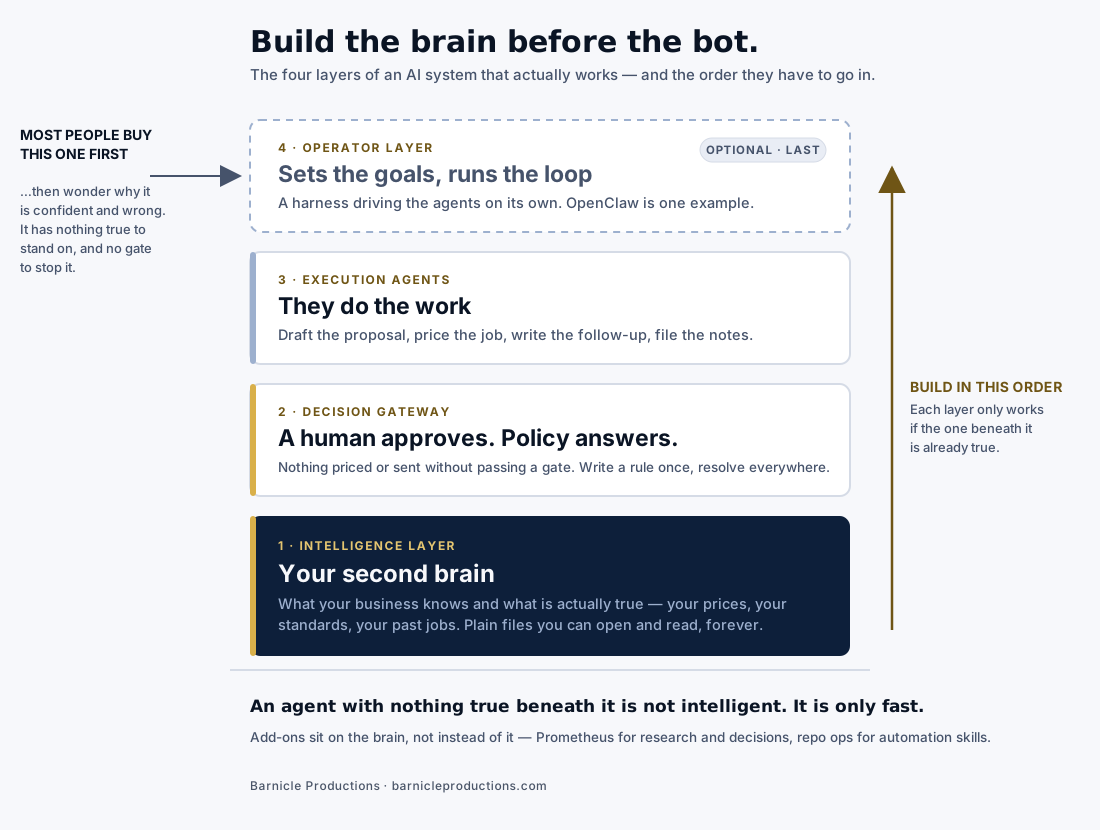
These terms are often treated as interchangeable, but they describe different levels of control.
- A prompt is a request or set of instructions given to a model.
- A model is the reasoning engine that interprets those instructions.
- An agent is a model assigned a defined job, approved inputs, tools, outputs, limits, and failure conditions.
- An agentic workflow is the complete sequence of agents, deterministic software—ordinary code that follows fixed rules—handoffs, approvals, actions, and evidence required to produce a dependable business result.
In Brian's target system, a qualified agent is closer to a versioned job description and standard operating procedure than a clever prompt. Its definition should say what triggers it, which sources it may read, what output structure it must return, which tools and write paths it may use, what it must never do, when it must stop, who approves the result, and how the behavior was tested.
That creates a material difference between asking a capable model to “handle this” and running an approved workflow:
The distinction is not “Brian's agents versus OpenAI.” OpenAI, Anthropic, or another provider can supply the reasoning model inside one of these agents. Codex itself supports persistent project instructions, reusable Skills, tool connections, and delegated subagents; those pieces can be combined with tests and enforcement hooks to implement governed workflows. OpenAI's Codex customization overview
The actual comparison is therefore:
A free-form request to a powerful model versus a versioned, tested, permissioned process that may use that same powerful model inside it.
Start with one capable agent; add more when the work justifies it
More agents are not automatically better. For sequential knowledge work, Brian's default is one capable agent with the smallest complete context, plus an independent check when the consequence warrants one. Parallel workers are added only when the branches are genuinely independent, isolation is important, elapsed-time savings justify the extra reconciliation, or one worker needs to challenge another from a meaningfully different role.
Every branch still needs defined inputs, an expected artifact, an acceptance test, a return path, one named merge owner, and preset limits on branches, time, and cost. A second agent is not automatically an independent reviewer if it receives the same assumptions, the same incomplete summary, and the same missing evidence. Most importantly, the system should never create consequential output faster than an accountable person can actually review it. Human approval is meaningful only when the reviewer receives the relevant evidence and limits, has enough time and understanding to evaluate them, and can stop the action. OpenAI's own Codex guidance similarly recommends parallel agents first for bounded, read-heavy work—separate workers mainly inspecting information—and warns that parallel write-heavy work—several workers changing overlapping files—adds model usage, conflicts, and coordination overhead. OpenAI's Codex subagent guidance
In the Walkthrough-to-Scope system, for example, separate media-recovery or transcription jobs can run independently once their boundaries are clear. The final scope cannot be manufactured by several workers making incompatible assumptions about the same missing measurement. Parallelism is earned capacity, not proof of intelligence.
Concrete case: the Walkthrough-to-Scope Automation
The implementation examples below are internal evidence supplied by Brian's own systems. They are self-reported and have not been independently audited.
The clearest working example is the system Brian built for turning a narrated field walkthrough into a reviewed scope and client presentation. This is not one prompt that says, “Watch these videos and make me a proposal.” It is a staged evidence pipeline:
field videos and photos
→ governed project intake and preserved originals
→ chronological capture blocks
→ audio and transcription
→ transcript cleanup
→ reviewed zone assignment
→ zone-scope extraction
→ domain analyst
→ decision filters
→ estimate-input handoff
→ proposal, deck, or unlisted client-review-site draft
→ human review
→ client delivery and receipt
Each stage has a narrower job and a different stopping rule:
The workflow has already produced an internal pilot: field media was processed into zone-based project records, a vetted scope, a branded proposal deck, and an unlisted client-review website instructed not to appear in search engines. A corrections loop preserved new domain knowledge as reviewable changes. Decision filters reduced repeated questions by applying settled rules while routing the remaining exceptions to Brian.
The cases where it stopped are as important as the output it produced:
- Final pricing did not proceed when the walkthrough lacked the necessary measurements.
- An uncertain plant identification remained a confirmation request instead of becoming a confident scope claim.
- A wild-mushroom question was routed to hands-on human identification because a photograph was not sufficient for a food-safety conclusion.
- Raw media remained private, and publication checks included faces, addresses, and readable license plates.
- Structural, drainage, pricing, contract, client-delivery, social-posting, and final-handoff decisions remained human-gated.
This is what an agentic workflow adds: not merely more steps, but explicit places where the system refuses to improvise.
The honest maturity statement matters. The internal pilot demonstrates the workflow's value, and the local capture application, contracts, handoff builders, measurement logic, review flags, and sample pipeline have automated tests. But the reusable product remains partly local-first. Live GoHighLevel and Google Drive integration, generalized cloud sync, multi-user authentication, and end-to-end live transcription are not all implemented. The estimator boundary still uses local or mock pricing logic, and final client pricing remains human-controlled. One successful pilot is evidence of a working path—not proof that every client and industry variation is production-qualified.
Concrete case: lead-to-proposal is a chain, not one sales agent
The business-agent suite defines a separate path for turning an inquiry into a proposal candidate:
Unified Inbox and Drafted Response Agent
→ Lead Qualification Agent
→ Project Memory Agent
→ Proposal Builder Agent
→ Brand Voice and Claims Review
→ Brian's approval
→ authorized delivery
The Inbox Agent may categorize a message, assign urgency, prepare a draft, and recommend routing. It may not send, delete, create a CRM record, schedule work, or promise pricing. The Qualification Agent evaluates fit and missing information but cannot reject the lead, issue a final quote, or book the job. Project Memory proposes a durable update without overwriting the source. The Proposal Builder creates a structured internal outline, preserving missing measurements, pricing risks, exclusions, and source conflicts. Brand review checks tone and unsupported promises. Brian remains the acceptance and release gate.
That is substantially different from asking one general agent to read an email, decide whether the customer is desirable, remember the exchange, calculate a price, write the proposal, and send it. Even if the general agent produces an excellent result once, it has combined several authorities that the business may want separated.
This chain is also not being presented as finished production automation. As of the current internal review, its six priority agents are all in_review, supported by local synthetic test cases only. None is approved for real client data, a live inbox, CRM write-back, autonomous scheduling, final proposal generation, or sending. That status is part of the glass box.
Concrete case: a meeting may suggest memory, but it may not rewrite history
A meeting workflow creates another necessary separation:
transcript or voice notes
→ Meeting and Call Summary Agent
→ proposed decisions, actions, open questions, and follow-up
→ Project Memory Agent
→ conflict and source review
→ Brian approves what becomes durable memory
The summarizer can distinguish confirmed decisions from assumptions and preserve useful client language. It cannot invent a decision, silently turn a discussion into a promise, send the follow-up, or make its summary the official project history. The Project Memory Agent proposes the exact save-back, while the existing source and any “do not save” or sensitivity labels remain visible.
This protects the brain from one of the most common long-term failure modes: an AI-generated summary gradually replacing what the people actually said.
Concrete case: supported content can still remain unauthorized to publish
A bounded internal research-to-content experiment tested the path from evidence to reusable content without letting the content generator decide what counted as truth or what could be published:
source inventory
→ individually reviewed pilot subset
→ claim and contradiction records
→ Brian's truth decisions
→ released Truth Packet
→ private master and derivative drafts
→ complementary verification
→ business-acceptance gate
→ separate publication gate
The source inventory contained 184 uploads, but the system did not pretend that inventorying them meant understanding all of them. Eleven pilot transcripts were individually reviewed, 25 outside sources supported 11 selected claims, and 43 higher-risk leads remained held for later work.
The first content bundle included a subtle but meaningful error: one derivative dropped the word “approximately” from a research claim. A broad verifier missed it; a complementary claim-level verifier caught it. The failed version was preserved, one line was corrected, the artifact hashes—digital fingerprints used to detect file changes—were regenerated, and the 44-file return bundle passed its integrity checks.
Even after that technical pass, business acceptance remained pending and publication remained unauthorized. This demonstrates the distinction at the center of the architecture:
A claim can be supported. A draft can be structurally valid. Neither fact grants permission to publish it.
It also shows why “have the agent review its own work” is not enough. Different checks need different responsibilities, and a successful integrity check is not the same as factual approval, business acceptance, or publication authority.
Concrete case: the search and answer-engine intake gate demonstrates hard enforcement
The search-engine optimization and answer-engine optimization—SEO and AEO—control plane is the clearest implemented example of moving beyond instructions into software-enforced boundaries. A specialist does not receive an informal request and begin changing a website. The local system requires an exact work order, an authorized scope, a candidate-only producer, independent validation, and a receipt. Missing or invalid authorization prevents dispatch. Production deployment is separately disabled.
This illustrates the difference between soft controls and hard controls:
Soft controls are still valuable. They guide judgment, tone, uncertainty, and escalation. But a model can misunderstand them, retrieve the wrong memory, lose a condition during compaction, or follow hostile instructions hidden in outside content.
A soft control asks the AI not to cross the line. A hard control makes the other side of the line unavailable.
“Never email a client without permission” is only a soft control when it lives in a prompt. It becomes a hard control when the agent has no sending credential until a fresh authorization grants one exact recipient, message, and expiration period.
Not every useful agent should be able to take the final action. Brian's Backup Guardian has passed internal tests. It audits Git—the version-history system—local-backup, offsite-backup, and restore evidence as separate lanes, but it cannot run a backup. Its value is accurate inspection and escalation, not autonomy for its own sake.
Hard controls are not infallible; software can contain bugs or be configured incorrectly. They must be tested, monitored, and reviewed. But they move consequential safety away from the model's memory and into enforceable system boundaries.
The durable design principle is:
The model may change. The operator may change. The approved workflow, sources, permissions, evidence, and business history should remain under the business's control.
OpenClaw could operate these workflows once it is connected, permissioned, and qualified. Codex or Claude Code can build, inspect, and run supervised stages. A local model can handle a bounded private step, while a frontier model handles difficult reasoning. What keeps the brain true is not the model's brand. It is the separation of jobs, the approved handoffs, the blocked actions, the independent checks, and the owner's authority over what becomes accepted knowledge.
That is the target architecture, not a claim about the current installation. OpenClaw is not presently operating Brian's governed brain end to end. The working examples above were produced through their documented combinations of local applications, scripts, structured files, Codex-assisted work, deterministic checks, and human review.
Current implementation status at a glance
These statuses are based on Brian's internal agent registry, test reports, pilot handoffs, and decision logs current through August 6, 2026. They are included because a governed system should make unfinished work as visible as finished work.