
Learning Log
What Should a Small Business Actually Do With AI?

Stop buying AI tools. Feed the one you have.
That's the whole strategy: write down what your business actually knows, put it in one place, let every tool and every employee answer from it, and keep a human on anything a customer will read. The rest of this post is what that looks like in practice — from our own books, mistakes included.
Here's the real issue
Tell ChatGPT about your business and it remembers — in that chat. It's genuinely good at this now. That's not the problem.
The problem is that your business doesn't talk through one chat window. It talks through your website's chat bubble, your booking auto-responder, your estimate template, whichever AI your new hire uses, and whatever tool you try next quarter. Your chat knows you. Nothing else does. Every other surface answers from the average of every business that looks like yours — politely, confidently, and slightly wrong.
Concretely: when someone asks your website at 9pm what a spring cleanup runs, the answer should come from your price sheet — not from what landscapers-in-general charge. So the real question isn't "which AI should I buy?" It's: where does the truth about your business live, and how many of your tools can read it? For most businesses the honest answers are "nowhere, consistently" and "none of them."
That's fixable. It's just not what anyone is selling.
What it looks like when the machine is fed
Watch where the marker stops. It parks on the human gate every run — that's not a loading animation, that's the rule.
Here's a real run, for a client of ours — a Connecticut contractor whose crews build patios, steps, and walkways. He walked one backyard talking into his phone for about 40 seconds. Nine sentences. This is a line from the entire input: "This patio goes 12 feet out from the house and it's 15 feet of patio."
His system already knew everything else, because we'd built it in ahead of time: his logo and colors, his example photos, his pricing calculator, his rules for what gets flagged for his judgment. So by the next morning — one day, start to sent — his customer had this:
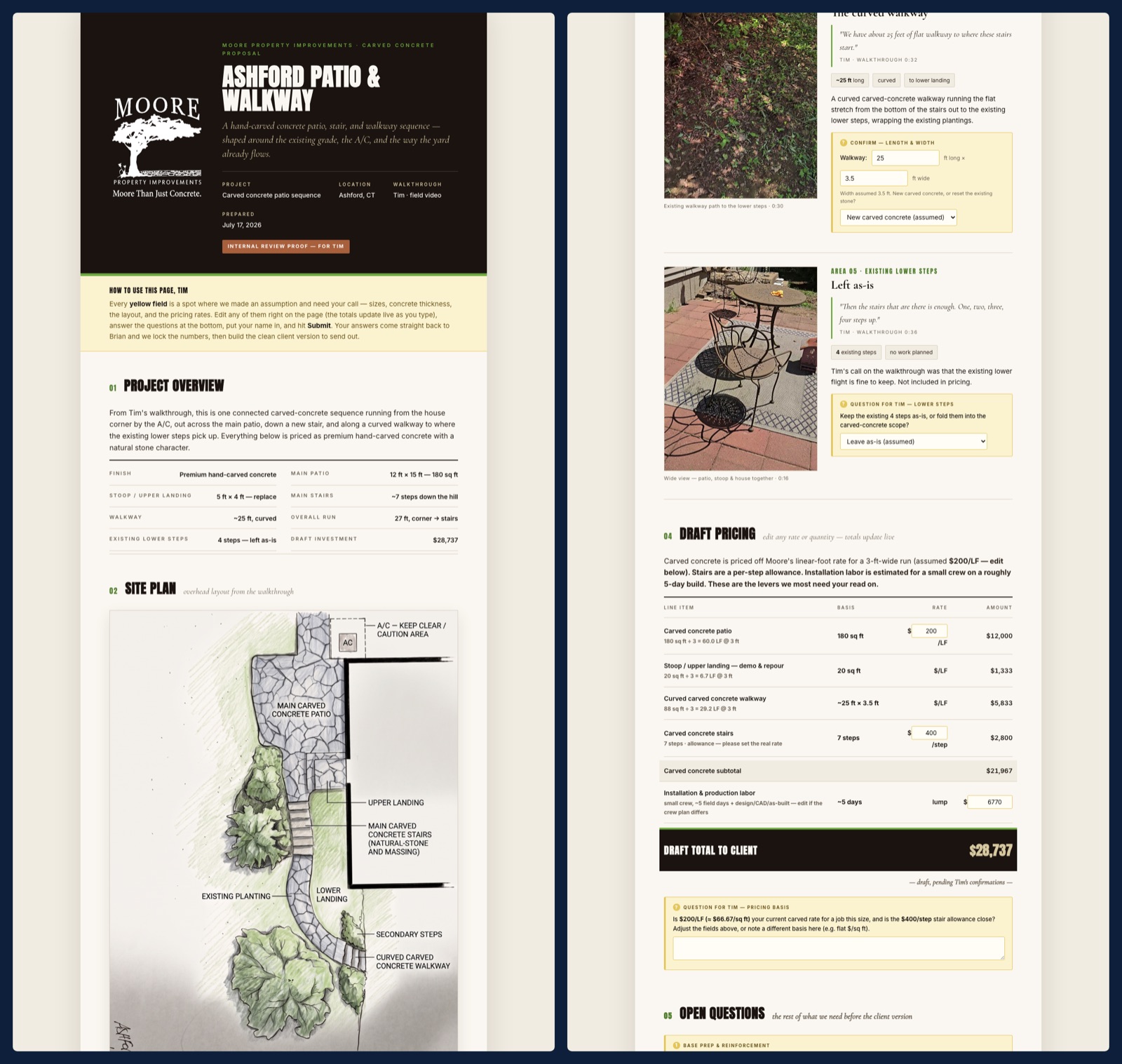
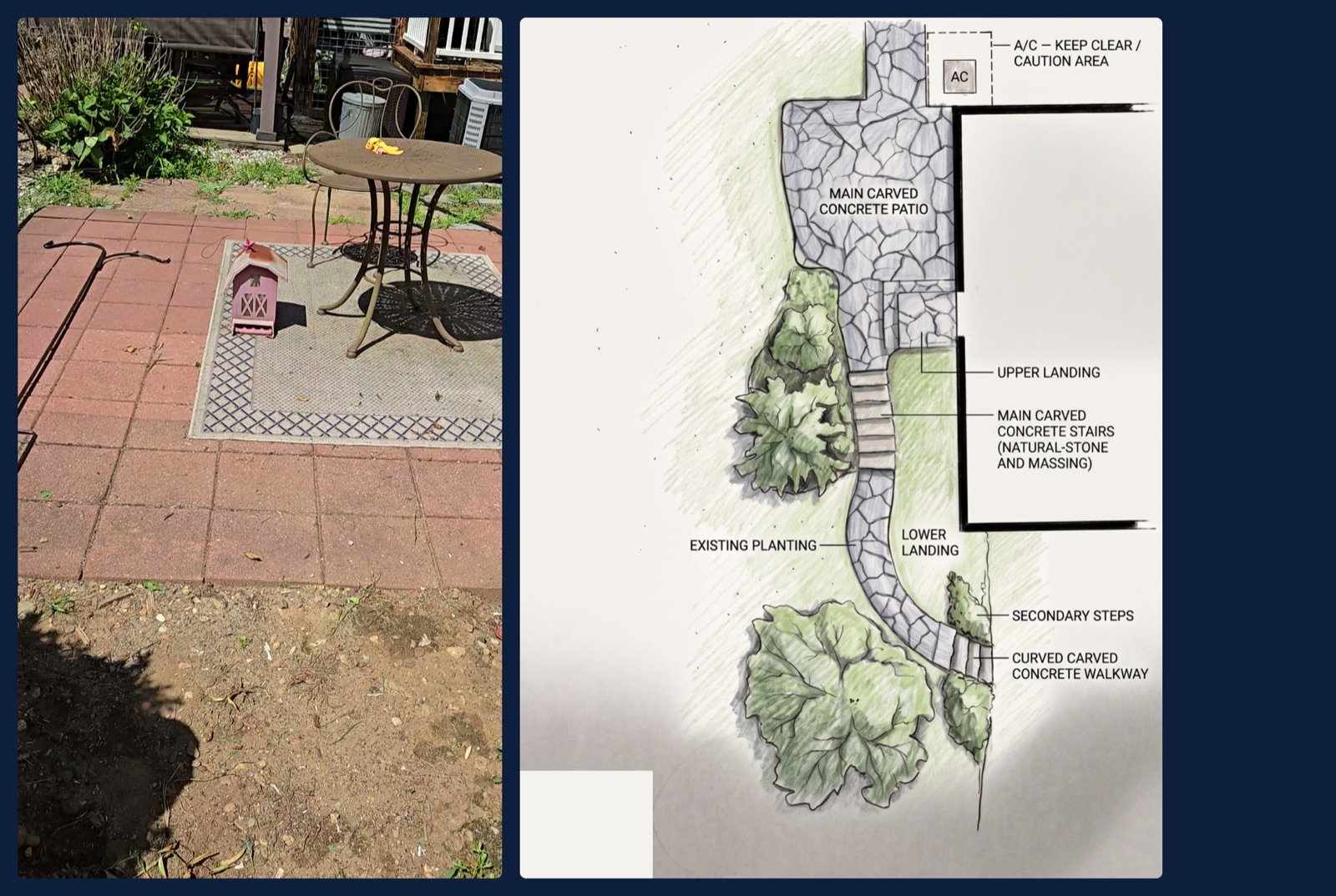
He read it, adjusted what needed adjusting, and sent it. The system drafted; he decided. Every price and every claim crossed his desk before the customer saw it.
A different build, for an ecological-landscaping company, is my favorite small receipt anywhere in this work: the phone transcription kept hearing "hookra." The system wrote Heuchera — a perennial — 31 times in one job. Not because the AI is a botanist. Because before it was allowed to guess at a single species, it got a 62-plant knowledge base built from that company's own plant list. An AI that has read the internet mishears with confidence. An AI that has read your business corrects the mishearing.
And the boring number underneath it all: 54,293 automated checks, zero failures on our own knowledge system since spring. A "check," concretely: does this note have a source, is it filed in the right place, does every claim trace back to where it came from. Small checks — that's why there are fifty thousand of them, and why the log stays clean.
Swap the yard walkthrough for a treatment menu, a service-call recording, or a punch list — the pipeline doesn't care which trade fed it. What it needs is the same in every case: your knowledge, written down first.
The three jobs worth giving it
-
Answering
The twenty questions you repeat every week — answered from your real pricing, your real service area, your real policies. At 9pm. In your voice.
-
Drafting
Follow-ups, estimates, the web page you've meant to write since 2023. The machine drafts; you ship. You stay the judgment, it becomes the typing.
-
Digesting what you already record
Walkthrough videos, voice memos, call notes — raw material you already collect. It should come back as proposals and pages, not sit in your camera roll.
The skip list — website chatbot, automated follow-up, the seven-tool stack — is really a not-yet list. Every one of those becomes safe the day it has your written-down knowledge to answer from, and stays dangerous until then, because until then it answers from the average.
Your first move (it's not an app)
If a sharp new employee started Monday, what document would you hand them?
That document is the project. The ten to twenty questions you answer constantly, one true written answer each. Where you find two versions of the truth — the website says one thing, the estimate template another — deciding which is real is the actual work, and it's yours. An afternoon and a pot of coffee, not a purchase.
When you want it built as a system — the one place, the tools wired to read it, the human gate on everything customer-facing — that's what we do: it's called an AI Business Brain, and it starts with a free AI & Operations Audit. Thirty minutes; we map what your business knows against what your tools can actually see, and you leave with your twenty-questions list either way — whether or not we ever talk again. The build itself is quoted after the audit, per business, because nobody should price a custom system off a blog post. Including us. Book the audit — and bring your messy business. Messy is normal. Messy is what the machine is for.
If you take one thing
The businesses I've watched win with AI aren't the ones with the most tools. They're the ones whose knowledge was written down where every tool could read it.
Don't buy another subscription this month. Write down your twenty answers. Everything good starts there.
Related reading
- Why Your AI Keeps Making Things Up About Your Business — The guessing problem from this post, explained properly: what's happening and why prompts don't fix it.
- AI Business Brain Foundation — The built-as-a-system version: your real answers, structured so every tool gives the same one.
- How the machinery is organized, for readers who want the deep end — the folder-and-plain-text method behind all of it.